
Wednesday, September 5, 2012
Demolition
Eighth grade students were excited to demolish their old cities, Bondidag Cove and Triana. I can't wait to see where their imaginations take them this year! The Future City theme is "Rethink Runoff!"


Saturday, August 18, 2012
Thursday, July 26, 2012

Wednesday, July 11, 2012
Destination Imagination
Team D.I.R.T placed third in the Destination Imagination State Competition in Joplin, Missouri! Congratulations to all their hard work!


I Wanna Be an Engineer
The junior high Challenge students created a parody of "I Wanna Be a Billionaire." They wrote the song, "I Wanna be and Engineer" to thank the Missouri Society of Professional Engineers (MSPE) for supporting the Future City Competition.
Tuesday, May 29, 2012
Caldwell Memorial Wildlife Area
Thanks to the Missouri Conservation Department and the Discover Nature Schools grant, Edgar Murray students had the opportunity to do field investigations at Caldwell Memorial Wildlife Area in Washington, MO. Using the Nature Unleashed curriculum, students participated in inquiry based activities at the pond, prairie, and forest. With out a doubt, their favorite location was the pond!

Sam Faith gives students last minute directions in the Prairie area. Students learned that prairies aren't always plains with wildflowers. Most of the prairies have very few trees because fires cleared the trees.

Students measure the temperature in various locations to see where they can find a comfortable fit for their randomly chosen cold-blooded animal. Students used strategies to change the temperature, such as placing the thermometer in the shade, sun, under a leaf, in a hole, etc...

Our parent chaperons helped keep our young scientists on track. The activities were student led, but our parent volunteers were available to help students with questions.

Jarod and Zachary view one of their living organisms through a hand lens. They got a close look at their frog's webbed feet, a specialized structure of their frog friend.
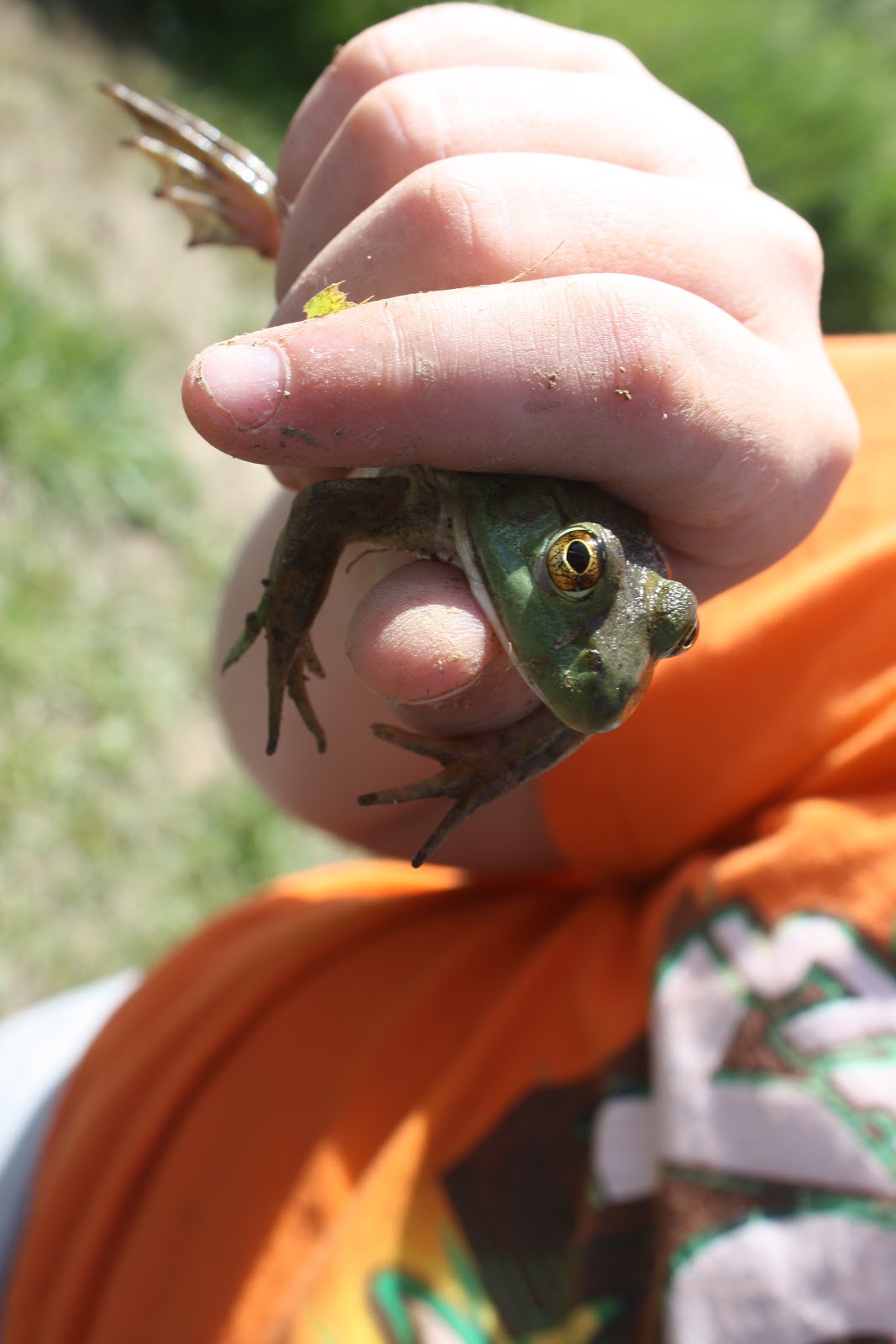 |
| Here is a closer look of our froggy friend! |


Jessica and Sophie discuss specialized structures they've discovered on living organisms in the pond.

Mrs. Hawkins enjoys observing an earthworm. Don't eat it Mrs. Hawkins!
 | ||
| Students collected living organisms to view under the microscope. |

Subscribe to:
Posts (Atom)